Roof Repairs
Repairs on Inner West terraces and semis, where box gutters, parapet flashings and shared roof junctions cause nearly every leak.
Learn more →Independent roof inspections for Inner West buyers, owners chasing a leak, and insurance claims. Box gutters, parapets and slate assessed properly.
Repairs on Inner West terraces and semis, where box gutters, parapet flashings and shared roof junctions cause nearly every leak.
Learn more →Re-roofing Victorian and Federation terraces, semis and workers cottages, including slate and heritage-area work.
Learn more →Colorbond and metal roofing across the Inner West, including the low-pitch and concealed-gutter roof forms common on terraces.
Learn more →Restoration for Inner West tile roofs, and recoating where a heritage conservation area limits what can change.
Learn more →Box gutter replacement and parapet flashing across the Inner West, the single most common source of ceiling damage on attached housing.
Learn more →Storm response across the Inner West, where a blocked box gutter can flood a ceiling within minutes.
Learn more →Most roof inspections in this area are requested by one of three people, and each wants something different out of it.
A two-storey Victorian terrace in Newtown or Balmain hides its entire drainage system from the street and from the open home. The box gutter, the sump, the parapet cappings and the junction with next door are precisely the expensive items, and precisely the ones nobody looks at before exchange. A roof-specific inspection tells you what you are buying.
Stain in the back bedroom in April, stain near the stairwell in July, nothing in between. These are almost always direction-dependent — a parapet that only wets through on rain from one quarter, or a gutter that only overtops at high flow. Systematic inspection beats another round of guess-and-seal.
An assessor wants dated photographs, a description of the failure mechanism, and a clear separation of storm damage from pre-existing wear. A written report provides that record.
Call (02) 8000 1103 to arrange one.
An Inner West inspection is not a walk over a tile field. The checklist follows the way these roofs are actually built.
Zero setback to the footpath, no side path, a 1.2 metre rear lane, two storeys and a parapet edge with nothing to tie to. That is a normal Inner West site, and it is why some inspections get declined elsewhere.
Methods are combined to get full coverage:
Anything that could not be sighted is stated as not sighted. A report that implies full access it did not have is worse than one with an honest gap in it.
Written in plain language, so a conveyancer, a strata manager or a family member can read it without a glossary.
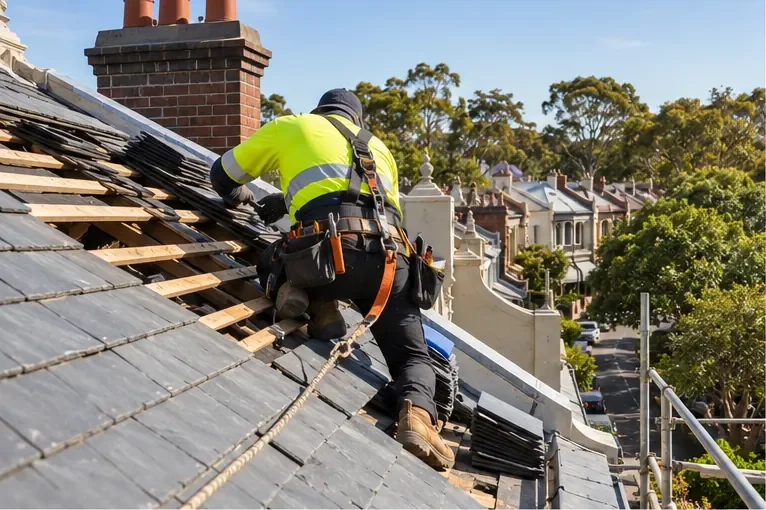
In the terrace belt — Newtown, Erskineville, Camperdown, Balmain, Rozelle, Annandale — the inspection is mostly about drainage and shared junctions.
Out through Strathfield, Burwood, Concord, Haberfield and Earlwood the roofs are detached with eaves, and the focus shifts to ridge pointing, valley condition, tile integrity and whether there is any sarking at all. The full list is on the service areas page.
Heritage status is noted where it is relevant to your options: much of the area falls within conservation areas across five councils, and that affects what can be changed on a street-facing roof. Hurlstone Park alone contains six conservation areas under the Canterbury-Bankstown LEP 2023.
Two different things, and worth being clear about:
Free inspection and quote. No charge, no obligation. We look at the roof, explain what we find, and give you a written quote for work we would carry out. This is what most people need.
Documented written report. A separate, independent deliverable intended to be handed to someone else — a vendor, a buyer, a strata manager, an insurer. Priced on the size and complexity of the roof and the access required.
Work is carried out by established, licensed and insured roofing contractors working to NSW Fair Trading requirements, and completed repairs carry a written workmanship warranty.
Call (02) 8000 1103 or request an inspection. If you want to know more about how this service works, see about us.
Tell us what you need and we'll get straight back to you. Prefer to talk? Call (02) 8000 1103 and speak to someone local.
Call (02) 8000 1103Partly, and rarely the part that matters here. A general building inspection typically views the roof from the ground or from a ladder at the edge, and a standard pre-purchase report will note what is visible. The box gutter between the parapets, the condition of its lining and sump, and the shared flashing with next door usually need somebody up there specifically looking at them.
Dated photographs of each element inspected, the covering type and its condition, the state of the box gutter or eaves gutters including sump and overflow provision, flashing and parapet condition, any structural concerns visible from the cavity, and a prioritised list separating what needs doing now from what can wait. Indicative scope for remedial work is included where you ask for it.
Usually yes, by combining methods. From inside the roof cavity, from an adjacent roof or window where that is available, from an elevated vantage point, and with aerial imagery for the slopes and gutters that cannot be reached. Where some element genuinely could not be sighted, the report says so plainly rather than quietly leaving a gap.
Those are the interesting ones, and they are usually wind direction dependent — a parapet that only wets through on driving rain from one side, or a box gutter that only overtops at high flow. Staining patterns, salt lines, debris marks in the gutter and moisture in the cavity timbers all tell the story even on a dry day.
No. The free inspection is what we do before quoting our own work — no charge, no obligation. A documented written report is a separate deliverable, produced as an independent record you can hand to a conveyancer, a vendor, a strata manager or an insurer. If you only want a quote for repairs, the free visit is all you need.