Roof Replacement
Re-roofing Victorian and Federation terraces, semis and workers cottages, including slate and heritage-area work.
Learn more →Leak repairs across the Inner West. Box gutter outlets, parapet flashings, party-wall junctions, slipped slate and chimney lead. Free written quote.
Re-roofing Victorian and Federation terraces, semis and workers cottages, including slate and heritage-area work.
Learn more →Colorbond and metal roofing across the Inner West, including the low-pitch and concealed-gutter roof forms common on terraces.
Learn more →Restoration for Inner West tile roofs, and recoating where a heritage conservation area limits what can change.
Learn more →Box gutter replacement and parapet flashing across the Inner West, the single most common source of ceiling damage on attached housing.
Learn more →Storm response across the Inner West, where a blocked box gutter can flood a ceiling within minutes.
Learn more →Roof inspections and written reports across the Inner West, including pre-purchase checks on terraces and slate roofs.
Learn more →Most calls begin the same way: a brown ring on a ceiling, a damp patch down a chimney breast, or paint lifting off a cornice. That mark tells us where the water came out. It rarely tells us where it got in.
Water on an Inner West roof travels. It runs along a rafter, crosses a ceiling joist, and finds the first crack in the plaster — which might be three metres and one room away from the actual failure. So the first job is tracing it back, not sealing the nearest suspicious-looking thing.
Call (02) 8000 1103 and describe what you are seeing. The inspection is free.
Terraces, semis and shopfront residences drain through a box gutter between parapets, into a sump, and out through one downpipe. On a Class 1 dwelling that gutter is sized for the 1% AEP five-minute rainfall burst, with a minimum 200 mm flat base and a 30 mm freeboard allowance for wind-driven spill. There is not much spare capacity in that design.
Block the sump with leaf litter, or lose 10 mm of fall to a century of settlement, and the water backs up over the rear of the gutter — straight into the roof cavity. Many older gutters also have no independent overflow discharging to atmosphere, which is now standard practice under AS/NZS 3500.3, so there is no safe release valve.
A parapet is a brick wall standing above the roof, wet on three sides. The capping on top cracks, the old damp-proof course has long since failed, and water soaks down inside the brickwork. It then exits wherever the wall is weakest, often at a window head on the floor below. This gets misdiagnosed as a window leak constantly.
Where your roof meets the neighbour's, there is one flashing serving two houses. Over decades it has been patched by different trades with different materials, and the silicone holding it together has gone hard and shrunk. Fixing it properly sometimes means working from the roof next door. We sort the access question out before quoting.
Victorian slate was fixed with iron nails. When the nails corrode the slate slides out, one at a time, usually landing on the footpath. The slate is often still sound — the fixing is not. Individual slates can be cut and hooked back in. If nail failure has spread across a whole slope, you are into a re-slate conversation.
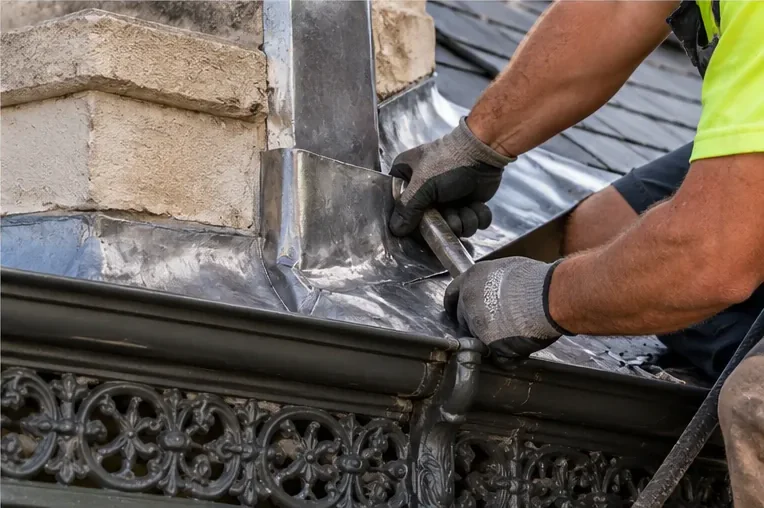
There are thousands of original chimneys across Newtown, Stanmore, Annandale and Balmain, many no longer in use. The stack brickwork is porous, the lead apron at its base has lifted, and the flue is open to the sky. Water comes down the inside of the stack and shows as a damp chimney breast indoors.
Not every roof here is attached. Across Strathfield, Burwood, Concord, Haberfield, Summer Hill and Croydon the stock is detached Federation and inter-war brick with real eaves. Those roofs leak in more conventional ways:
Those are usually accessible, lower-risk repairs. See roof restoration if the whole roof is tired rather than specifically broken.
If the inspection shows the roof is past patching, you will be told that rather than sold three more repairs. Roof replacement covers what that involves.
There are no fixed prices, and anyone quoting one over the phone has not seen your roof. What genuinely changes the figure:
You get all of that written down before anything starts. Nothing proceeds on a handshake and a guess.
Repairs run right across the 29 suburbs on our list — the terrace belt through Newtown, Enmore and Balmain, the Federation and inter-war middle through Haberfield and Burwood, and the Cooks River suburbs at Earlwood and Tempe. The full list is on the service areas page.
Work is carried out by established, licensed and insured roofing contractors working to NSW Fair Trading requirements, and completed repairs carry a written workmanship warranty.
Call (02) 8000 1103 or send the details through. No pressure, no obligation.
Tell us what you need and we'll get straight back to you. Prefer to talk? Call (02) 8000 1103 and speak to someone local.
Call (02) 8000 1103On a terrace or semi, almost nowhere useful is visible from the street. The likely sources are the box gutter behind the front parapet, the sump where it drains, the junction with next door, or the chimney lead. Water also tracks sideways along rafters and ceiling joists before it drops, so the wet patch is frequently a long way from the entry point.
It depends on what has failed. A split box gutter lining, a rusted sump or a dozen slipped slates are all worth repairing on an otherwise sound roof. If the battens are rotten, the slate nails have gone across the whole roof, or you have paid for the same leak three times, repairs stop being economical and a re-roof is the better spend.
Sealant has a place — bedding a flashing edge, finishing a penetration — but it is not a repair on its own. A silicone smear across a box gutter joint buys one wet season. We replace or reform the failed component: new lining, new flashing, a rebuilt sump, a proper overflow. You should expect to be told which one you are getting.
Active internal leaks are triaged first and looked at as soon as access allows. Non-urgent work is booked in. Scaffolding or a footpath permit adds lead time on tight sites with no setback, which is common through Newtown, Erskineville and Balmain, so that gets flagged at quoting rather than sprung on you later.
Mostly how hard the roof is to reach and how far the damage has travelled. A slate slipped off a single-storey cottage is a short visit. The same fault on a two-storey terrace with no side access and a scaffold requirement is a different job. Roof pitch, the material, and whether ceilings or timber have been wet all move the number.